

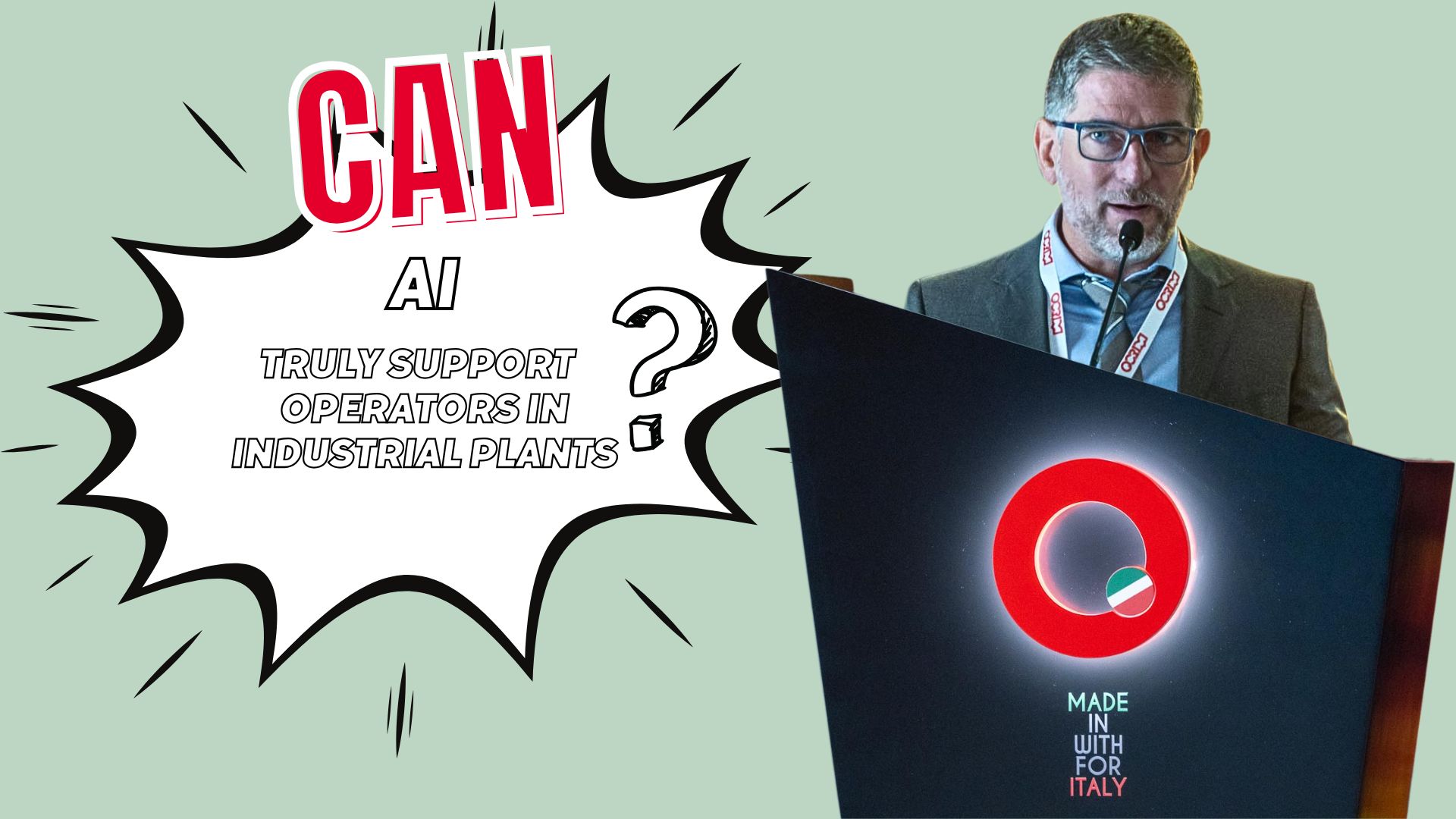
Interview with Paolo Molinari, Head of Automation Department at Ocrim.
Our “Ask the Expert” series continues with an in-depth look at Artificial Intelligence applied to milling plants, focusing on data security and the central role of the operator.
Paolo Molinari explains how Ocrim is currently exploring Artificial Intelligence within an experimental framework, aiming to ensure full data protection while providing reliable, practical support for operators’ daily activities.
Q: Why is Artificial Intelligence becoming increasingly important in industrial plants today?
A: Artificial Intelligence makes it possible to optimize both individual machines and entire plants, improving adjustments, energy consumption and overall performance. Everything, however, starts from one essential element: data. Without accurate and properly historical data, algorithms cannot learn, evolve or deliver reliable insights. We are referring to production cycles, energy consumption, machine settings and other key operational parameters that form the foundation of any effective AI application.
Q: How do you ensure the security of collected data?
A: We fully understand customers’ concerns: no data is shared with external platforms. Ocrim is developing an internal data collection and management structure based on its proven production management system, MES management@mill, ensuring maximum security without relying on third-party solutions. The entire “digital brain” remains within Ocrim — a controlled, protected and secure environment.
Q: Will Artificial Intelligence replace human operators?
A: Absolutely not. Artificial Intelligence is designed as a support tool, not a replacement. The operator remains at the heart of the process. Technology is developed to assist professionals in improving plant setup, machine adjustments and maintenance activities by providing targeted suggestions — for example through chatbot interfaces — while never replacing human expertise, responsibility or decision-making.
Q: How is data organized and managed?
A: Data is the true fuel of Artificial Intelligence. It must be clean, structured and historically stored within secure environments to be effectively consulted and analyzed for process improvement. As I often repeat, almost like a mantra, data accessibility is essential. Successful AI development relies on the well-known rule of the three “Vs”: Variety of content, sufficient Volume of information, and increasing Velocity of data acquisition. Thanks to IoT and to technologies and automation systems entirely designed and developed by Ocrim, multiple variables can now be monitored simultaneously, improving plant performance while reducing operational stress.
Q: Which AI developments is Ocrim currently focusing on?
A: We are working on several fronts. One of the most tangible examples is the development of a chatbot interface designed to support the consultation of manuals, operating procedures and maintenance documentation, while also providing real-time first-level assistance. Another area involves operator support systems capable of suggesting plant planning and operational strategies, always based exclusively on secure, internally managed data. In both cases, our objective is clear: to provide useful, reliable and consistent tools while keeping people at the center and ensuring maximum data protection.
Paolo Molinari concludes:
“Artificial Intelligence is still sometimes viewed with caution, especially when introduced into complex production environments. Nevertheless, its integration into everyday industrial operations is inevitable. For this reason, Ocrim is committed to ensuring that this transition takes place in a controlled, reliable and transparent way — placing technology at the service of people and reinforcing the operator’s central role within the process.”
This approach demonstrates how innovation and human expertise can successfully coexist, transforming data into concrete tools that enhance efficiency and process reliability.
m.l.

