

Ocrim and Paglierani’s technological solution for the Pohronský Ruskov mill
In the flour market serving large-scale retail, the ability to adapt quickly to different packaging formats has become a strategic factor. Today, competitiveness is no longer driven solely by productivity, but by industrial flexibility, logistics efficiency and the ability to enhance product presentation on modern retail shelves.
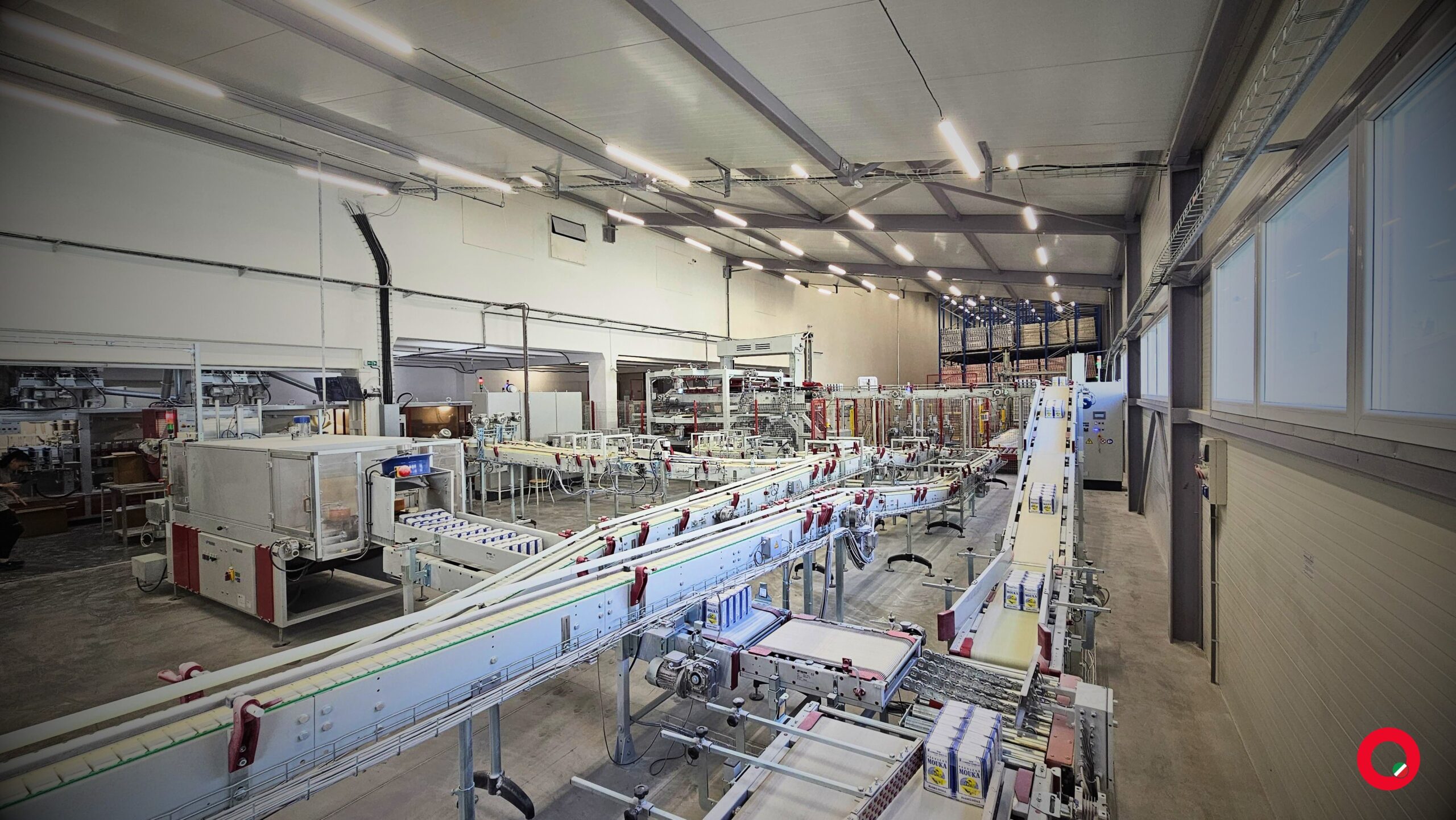
This is the context behind the project developed for Pohronský Ruskov, a leading mill in the Slovak Republic. The request was both simple and ambitious: to implement a single integrated packaging line capable of handling preformed and pre-printed bags, single bags, shrink-bundled packs and case-packed formats, all within one coordinated system.
To meet this challenge, Ocrim and Paglierani designed a complete, high-performance packaging line combining high output with maximum operational versatility, enabling the mill to respond efficiently to changing market requirements.
Different packaging solutions for different markets
The availability of multiple packaging formats is the result of precise commercial and distribution strategies.
Preformed bags were selected for their fast format changeover, a key advantage in dynamic markets where packaging specifications frequently change.
Case packing, on the other hand, is designed to enhance premium products. A solid, well-finished case contributes to stronger brand positioning and improved shelf perception within large-scale retail environments.
Shrink bundling represents the most straightforward and cost-effective solution, particularly effective in optimizing packaging costs and simplifying logistics handling.
A high-capacity packaging line
The line developed for Pohronský Ruskov also stands out for its industrial performance.
Production capacity reaches up to 200 bags per minute, corresponding to approximately 12 tonnes per hour in the 1 kg format.
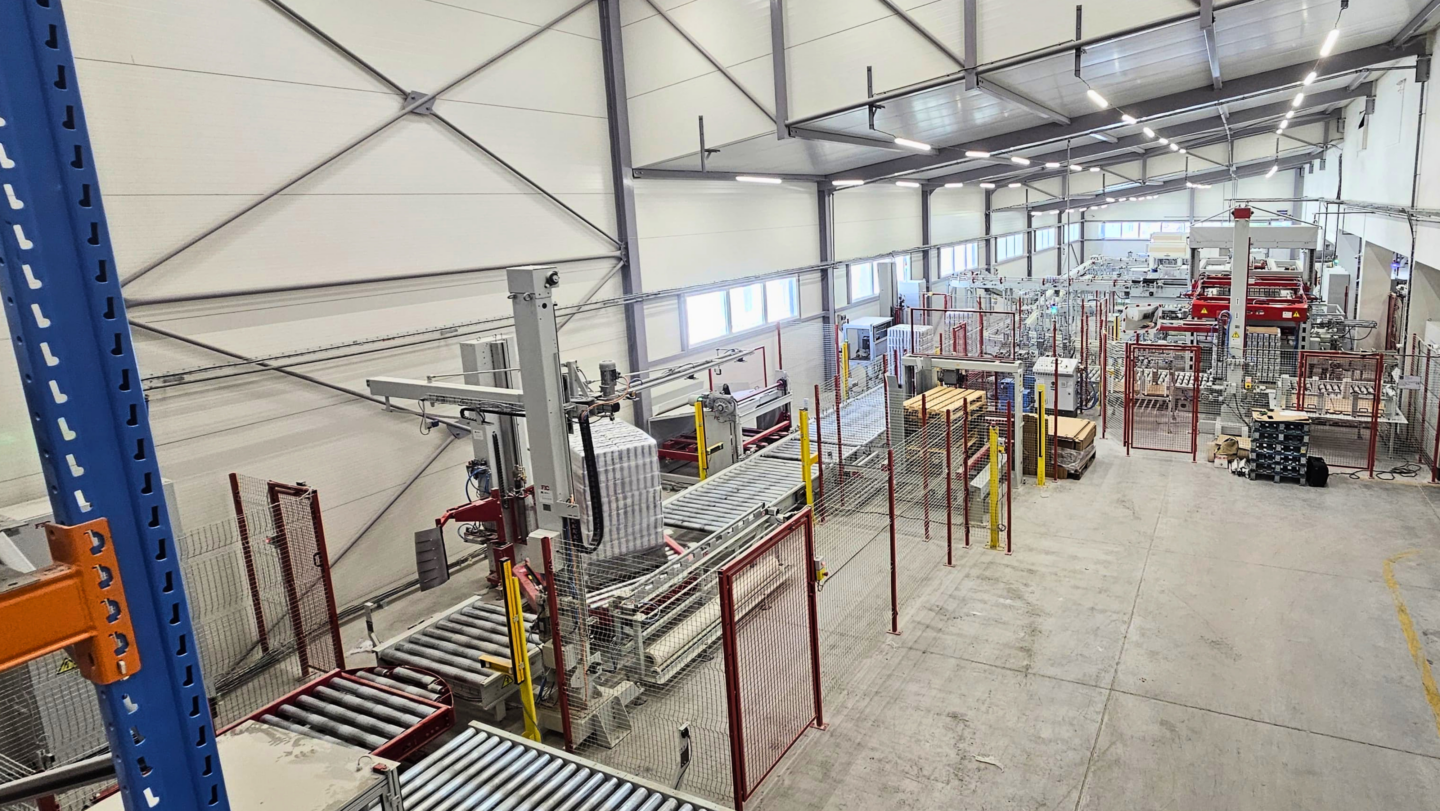
Achieving this level of output requires not only accuracy in primary packaging, but also seamless integration of end-of-line operations. For this reason, the system is completed by a fully automatic palletizing and stretch wrapping system, designed to handle finished products efficiently and prepare them for distribution.
Technology serving flexibility
The result is a system that allows the Slovak mill to operate with a high degree of flexibility, meeting the demands of large-scale retail while maintaining high standards of productivity and packaging quality.
This project demonstrates how, in the milling sector, technological innovation is not simply about increasing output, but about developing complete industrial solutions capable of evolving alongside the market.
Below is an overview of the operational flow, from primary packaging through to the final logistics configuration.
From filled bag to end-of-line operations
Once filled, the 1 kg bag can follow two alternative secondary packaging routes, depending on logistics and commercial requirements.
When shrink bundling or case packing is required (10 kg format), the bags are conveyed either to the shrink bundling system or to the case packing line. The process includes:
• grouping of 10 bags;
• arrangement into two rows of five;
• formation of either a shrink-bundled pack or a 10 kg case.
This format represents the standard handling and distribution unit.
Alternative line for single bags
Alternatively, the 1 kg bag can be processed without secondary packaging. In the single-bag line, each bag is:
• flattened and oriented;
• marked to ensure batch traceability;
• inspected through quality control systems, including metal detection and check weighing, to ensure product integrity.
Automatic palletizing and stretch wrapping
The next stage is automatic palletizing, which can involve:
• 10 kg cases;
• 10 kg shrink-bundled packs;
• individual 1 kg bags.
The units are arranged on Düsseldorf pallets (600 × 800 mm).
Once pallet loading is complete, the load is stabilized using a stretch wrapping machine, ensuring safety during handling and transport.
Final logistics configuration
The process concludes with the formation of the final logistics unit.
Two Düsseldorf pallets (600 × 800 mm) are placed on a Euro pallet (800 × 1200 mm). This configuration ensures:
•improved load stability;
•optimized transport space;
•full compatibility with standard European logistics systems.

